
Since its founding in 1984, Uniqlo has grown from a single store in Hiroshima to a global apparel brand with thousands of locations worldwide. This includes over 100 stores in North America, and more than a thousand in Greater China.
As Uniqlo’s retail footprint has grown, so too has its status as a Meaningfully Different brand. The result of this combination is outsized brand value gains. Uniqlo joined the Kantar BrandZ Top 100 Most Valuable Global ranking in 2025 as the world’s 97th most valuable brand, with its latest position to be revealed on 14 May 2026. It also moved up one place in the latest BrandZ Japan ranking, becoming the country’s third-most valuable brand.
While Uniqlo has long been a brand to watch, its current success is something new. Before the 2020s, its brand value growth largely tracked the pace of new store openings. But ever since then, it has taken off. For the past six years, Uniqlo’s brand value has accelerated well above its retail footprint growth.
How has Uniqlo done it? First, it has unlocked demand, both present and future, through superior Meaningful Difference. And second, it has used intelligence to drive constant innovation and smarter marketing.
The result is a brand that more than delivers on its core promise of LifeWear, stylish, easy clothes designed for real life.
Building value beyond price
Uniqlo has enjoyed five straight years of annual profits. That’s no small feat for any apparel brand, not least given this decade’s challenging trade conditions. But it’s especially impressive that Uniqlo has grown while also executing a long-term strategic pricing shift.
Uniqlo was once seen as a ‘budget’ brand. Today, it’s an elevated ‘mid-range’ player. How did Uniqlo pull this off? By doubling down on the factors that have always made the brand seem not just fairly priced, but truly valuable. Think subtle design touches, nuanced colourways, exclusive cultural collaborations, and a reputation for longer-lasting quality.
Over time, these factors have all fed into Uniqlo’s clear brand equity advantage, now evident in signal intelligence from BrandSnapshot, Kantar’s free brand equity assessment tool powered by BrandZ.
Excellent quality, elevated aesthetics and a strong brand philosophy are hallmarks of Japanese brands. Yet even in this context, Uniqlo stands apart for its Meaningfully Different connections with consumers.
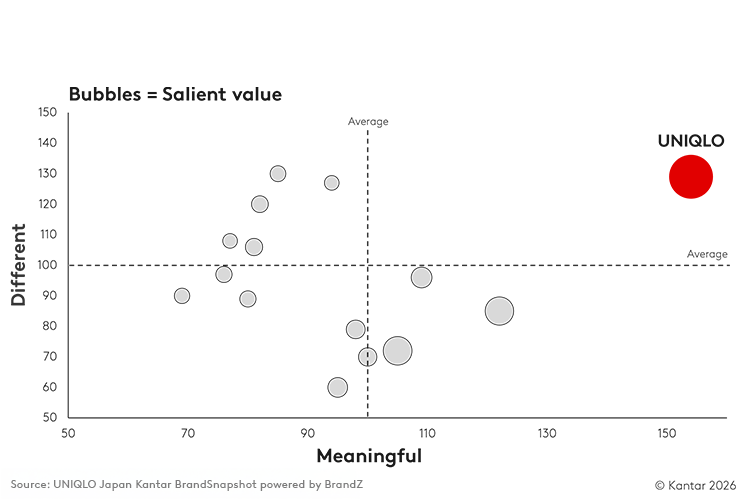
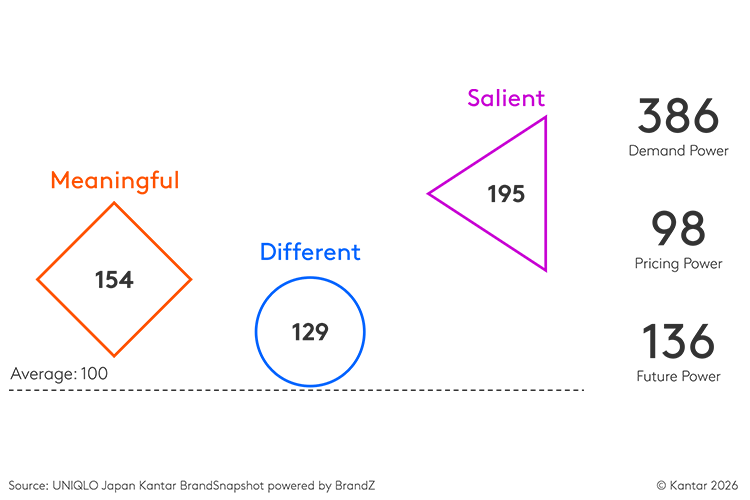
A closer look at the fundamentals of Uniqlo’s brand equity makes this even clearer, especially considering the brand’s robust Meaningful Difference in BrandSnapshot data. This strength allows Uniqlo to go beyond salience alone, to build real connection. It also underpins the brand’s ability to drive volume share (Demand Power) and inspire future choice (Future Power).
This places Uniqlo firmly in the Iconic brand archetype - large, strong brands well positioned for continued growth.
Standing out by fitting in
And yet, Uniqlo carries itself rather differently from other ‘iconic’ apparel brands. Its clothing isn’t logo-heavy, and its advertising isn’t boisterous.
This kind of lower-profile positioning wouldn’t work for every brand, but it fits perfectly with Uniqlo’s LifeWear ethos. Somewhat counter-intuitively, Uniqlo is a brand that stands out for how well it fits in. Its superpower lies in intelligent versatility.
This quiet adaptability has helped Uniqlo thrive on popular platforms like TikTok, particularly through user-generated content. Its products act as compelling co-stars, enhancing creators’ scenarios without upstaging the talent.
Uniqlo’s appeal is far from limited to younger audiences. Millennials and Boomers have also embraced the brand, reinforcing its broad, cross-generational relevance.
Despite releasing fewer new styles each year than its competitors, Uniqlo brings together diverse audiences by making fewer, better product bets. When it does introduce new garments, they are designed to work across segments.
Where intelligence drives impact
Call it ‘mass’ without the blandness. Uniqlo’s cross-generational, cross-segment appeal lies at the core of its Meaningful Difference. But how does the brand remain adaptable and appeal to so many different segments while staying memorable?
The answer lies in its robust intelligence engine. Simply put, Uniqlo is fanatical about gathering intelligence about how its clothes perform in the real world. This mindset is embedded in a sophisticated in-house Customer Centre in Tokyo, capturing feedback across channels and tracking sentiment through social listening and digital analytics.
These signals feed directly into marketing, enabling fast, informed responses in dynamic environments like TikTok and Douyin. This includes identifying and amplifying emerging ‘hero’ products, while shaping creative and investment decisions.
The same intelligence powers Uniqlo’s R&D engine. Consumer feedback leads to tangible improvements, from softer yarns to better-performing materials, while also informing entirely new ranges. It also supports continuous refinement. Core products like oxford shirts and denim are iterated year on year, with even the smallest details, down to button stitching, carefully optimised.
At a broader level, Uniqlo tracks global lifestyle shifts to inform its strategy. As dress codes relax in many markets, the brand adapts its offer accordingly, balancing formalwear with more casual, everyday pieces.
Scaling for global growth
At Uniqlo, investing in great intelligence isn’t merely a way to support brand strategy; it is brand strategy. That’s a mindset that more executives should adopt.
Uniqlo’s ambition is nothing less than to become the world’s largest apparel brand. Its BrandSnapshot data shows that it is well-equipped for that journey.
That said, not all markets have been a natural fit for Uniqlo. Before pivoting to major US metro areas, Uniqlo struggled to gain traction in suburban locations. This helps explain why the brand still has far fewer stores per capita in the US than in China.
That gap also points to opportunity. There is significant untapped growth in regions such as Texas and the US Southeast, if Uniqlo can adapt its brand experience to succeed in smaller shopping malls.
The brand will also need to address friction in its online and omnichannel experiences, with the same attention to detail it applies to product performance.
What this means for marketers
Ultimately, Uniqlo’s high Future Power score suggests strong growth potential. When the brand makes itself more available, demand tends to follow.
So, what can marketers learn from Uniqlo’s success?
First, value matters more than price when that value is consistently communicated.
Second, Meaningful Difference is a growth driver above and beyond macro category factors.
Third, mass brands can still succeed worldwide, but only if they’re relentless in turning intelligence into marketing advantage.
Discover how the world’s most valuable brands win, when the Kantar BrandZ Most Valuable Global Brands Report is revealed on the 14th of May. Register now to join the launch webinar and explore the signals, decisions and strategies accelerating the brand economy.
Kantar BrandSnapshot is a free interactive tool powered by BrandZ’s wealth of data and validated Meaningful Different and Salient framework. Designed to give you a complete picture of brand equity in competitive context, BrandSnapshot delivers insights on over 15,000 brands in 40+ markets.
Ready to outfit your brand for the future with the latest, greatest signal intelligence? Explore BrandSnapshot on Kantar Marketplace for free today.